Under far-right attacks, the book world stands strong in resistance
Stella Magliani-Belkacem and Jean Morisot
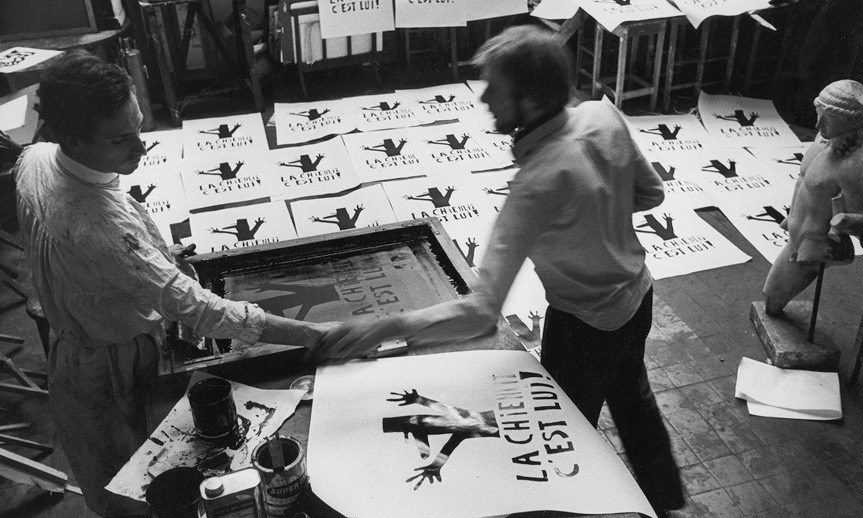
We are publishing a commentary by our colleagues and comrades Stella Magliani-Belkacem and Jean Morisot of the Paris-based publishing house La fabrique. In their article on the dominance of the far right in the public sphere, which appeared in Le Monde on December 2, 2025, the publishers stress the importance of independent presses and express their concern about “the climate of witch hunts that is spreading at all levels of French society.” In a gesture of solidarity, their text is translated into German and English to highlight parallels with the local situation.
***
There are several ways in which the right and the far right—each day more indistinguishable from one another—target the world of books, which they fear by its very nature. They may, for example, spend millions buying up publishing houses in an effort to turn them into outlets for their ideologies, or they may attack whatever resists them through a multiplication of assaults and slanderous campaigns. Whether one falls victim to one or the other of these strategies, it is important to remember that they are complementary and, in a sense, perfectly aligned.
The denunciation of the crimes committed in Gaza by the Israeli army has provided new leverage for these smear operations, as publications or figures rooted on the far right of the political spectrum have suddenly discovered a vocation for combating antisemitism—without much regard for those most directly affected. They now engage in hasty exegesis through media campaigns that target books, their publishers, and their authors, resulting in public condemnation. Our publishing house, like others, has repeatedly borne the brunt of these attacks, for reasons that have varied over time. Not long ago it was “eco-terrorism;” today it is “historical revisionism.”
Yet a book has a lasting nature: its pages cannot be deleted the way a tweet can. What is written is governed by law, and legal institutions ensure that those laws are upheld. Anyone can freely consult a book’s contents through the public library system. And it remains possible, through rigorous public debate, to confront the divergent viewpoints expressed within. There are thus multiple ways to verify that these campaigns are deceitful. But this matters little to those behind them, for their objective lies elsewhere: to relentlessly silence any expression of solidarity with the Palestinian people, to pillory subversive voices, to protect the climate status quo, and to foreclose any prospect of social transformation.
What is most alarming in all this is the far-from-coincidental convergence of Trump-style outbursts—“antiracists are racists, environmentalists are terrorists,” and so on—the proliferation of attacks on bookstores, and the increasingly repressive posture adopted by public authorities toward books and critical thought. In just the past few weeks, dozens of bookstores have been attacked, their storefronts vandalized, their events disrupted by individuals or groups who feel entitled to censor books by force, while the competent authorities have raised no objections. We have seen an academic conference on Palestine suspended by the Collège de France—a first since the Second Empire. We have seen elected officials on the Paris Council succeed in canceling a grant to forty independent bookstores. We have also seen an Italian illustrator turned away at Toulouse airport and prevented from taking part in a comics festival on the grounds that her presence constituted a “threat to public order” due to her antifascist positions. These developments give ample cause for concern—and at least one reason for encouragement. Amid the witch-hunt climate taking hold at every level of French society, the world of books is holding its ground in resistance.
It does so thanks to independent publishers who safeguard editorial diversity and the circulation of minority viewpoints; thanks to booksellers who do not yield to pressure from hooded censors and who preserve, as best they can, an essential space for discussion; and it will continue to do so through the active solidarity of all its participants whenever one of them is mistreated by the state or by fascist-leaning groups. Is this not, after all, one of the lessons of historical antifascism? Never lower your head.
Stella Magliani-Belkacem and Jean Morisot are co-directors of La fabrique éditions, a publishing house founded in 1998 by Éric Hazan. An excellent portrait of La fabrique was published in 2018 on the occasion of its 20th anniversary: Twenty years of La Fabrique.
***
By the way, Dagmar Herzog’s The New Fascist Body / Der neue faschistische Körper continues its reception in both English and German press: In Deutschlandfunk and Deutschlandfunk Kultur, in an interview by Lisa Schmidt-Herzog for New Books in Critical Theory, and in Raúl Krauthausen's podcast Im Aufzug. Last but not least, Junge Welt and WOZ have reported on the book.